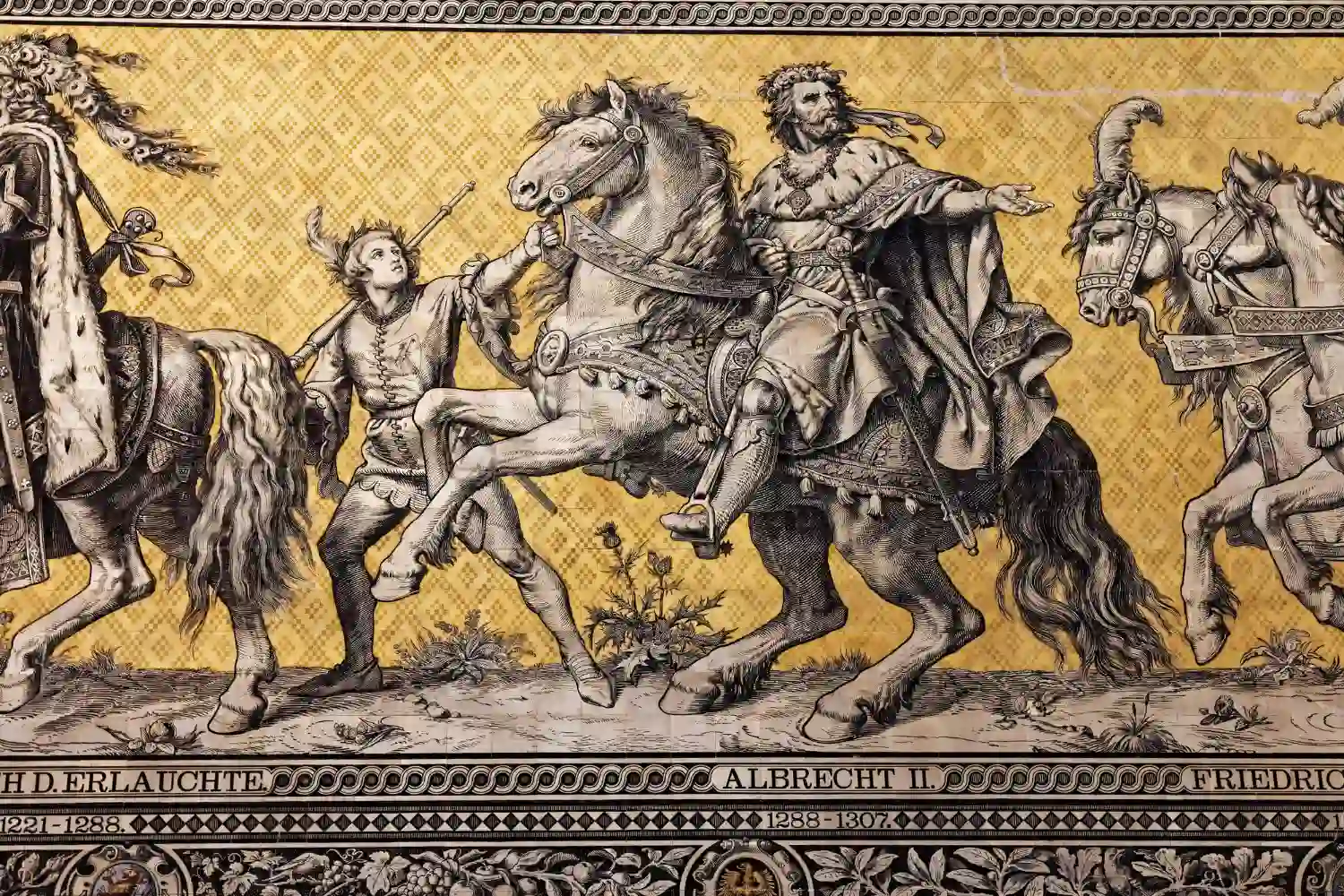
If you ask the average person about the Middle Ages, they usually picture mud, plagues, knights in clunky armor, and very dark, gloomy castles. They call it the “Dark Ages.”
But if you look at the art from this period (which spans roughly from the 5th to the 15th century), it wasn’t dark at all. It was blazing with gold leaf, vibrant stained glass, and colors so bright they hurt your eyes.
Welcome back to ArtVibe’s World of Art. We are leaving the serene minimalism of Japan behind and traveling to Europe. Here, art wasn’t just decoration; it was a book for people who couldn’t read. It was a tool to teach, to scare, and to inspire awe.
Why do medieval paintings look so “flat”? Why are the babies drawn like tiny old men? Why are there gargoyles on churches? Let’s unlock the secrets of the medieval mind.
It’s Not “Bad” Drawing, It’s Symbolic
One of the most common complaints from students seeing Medieval art for the first time is: “They forgot how to draw!”
They look at the perfect statues of Ancient Greece and Rome, and then they look at the stiff, flat figures of the Middle Ages, and assume humanity lost its skill.
Here is the truth: They didn’t want it to look realistic.
For the medieval artist, the physical world (the body, the earth) was temporary and sinful. The spiritual world (the soul, heaven) was eternal.
- Perspective: They didn’t use linear perspective because God sees everything at once.
- Scale: Size didn’t depend on how far away someone was; it depended on importance. This is called Hierarchical Scale. Jesus or a King is drawn huge; the common people are drawn tiny.
- The Background: You rarely see realistic landscapes. Instead, you see solid gold. This indicates that the scene is taking place in a heavenly realm, outside of time and space.
So, when you see a “weird” medieval painting, remember: They weren’t trying to paint a photograph of reality; they were trying to paint a map of the soul.
Byzantine Art: The Gaze of Eternity
In the East (centered in Constantinople), the Byzantine style reigned supreme. This art is famous for Icons and Mosaics.
If you walk into a Byzantine church, the walls seem to shimmer. This is because mosaics were made of thousands of tiny glass tiles (tesserae), often backed with gold leaf. They were angled slightly differently to catch the candlelight from every direction.
The Eyes: Notice the eyes in Byzantine icons. They are huge, wide open, and staring directly at you. This was intentional. The icon was seen as a window. You weren’t just looking at the saint; the saint was looking at you.

Edu-Zone: The Lost Art of “Illuminated Notes”
One of the greatest achievements of the Middle Ages was the Illuminated Manuscript. Before the printing press, every book had to be copied by hand. Monks would spend their entire lives in a scriptorium, copying the Bible or ancient texts. But they didn’t just write words. They decorated them. They turned the first letter of a page into a complex illustration, wrapped vines around the margins, and added gold accents.
Student Takeaway: Treat Your Knowledge with Respect.
In the age of laptops and quick screenshots, we treat information as cheap and disposable. We scribble messy notes that we never read again. But the medieval mindset teaches us that knowledge is sacred.
Try applying the “Illuminated Manuscript” method to your study notes:
- Structure matters: Don’t just write a wall of text. Use headers, bullet points, and margins.
- Visual cues: Use color coding. Draw diagrams. If you are studying biology, sketch the cell. If you are studying history, draw a timeline.
- The “Margin” concept: Medieval manuscripts had wide margins for “glosses” (commentary). Leave space in your notes to add your own thoughts later.
When you put effort into the presentation of your notes, your brain signals that this information is valuable. You retain it better. You stop being a passive “copier” and become an active “creator” of your own knowledge base.
Architecture: The Stone Bibles
Since most people were illiterate, the church building itself became a textbook. We can divide medieval architecture into two main eras.
1. Romanesque (approx. 1000–1150 AD)
Think “Fortress of God.”
- Walls: Thick and heavy.
- Windows: Tiny, because big holes would make the heavy walls collapse.
- Vibe: Dark, solemn, protective.
- Arches: Rounded, like the Romans used.
2. Gothic (approx. 1150–1400 AD)
This was a revolution in engineering and philosophy. The goal was Height and Light.
- The Pointed Arch: This allowed weight to be pushed downwards more efficiently than a round arch.
- Flying Buttresses: Those spider-leg looking stone supports on the outside of cathedrals (like Notre Dame). They held the walls up from the outside, meaning the walls didn’t need to be thick anymore.
- Stained Glass: Because the walls didn’t need to hold all the weight, they could be replaced with glass. Suddenly, the church was flooded with colored light. This was seen as the direct presence of the Divine.
Fun Fact: The term “Gothic” was actually an insult invented later during the Renaissance. It meant “barbaric” (like the Goths who sacked Rome). Now, we recognize it as one of the most sophisticated architectural styles in history.
The Grotesque: Why are there Monsters on the Church?
Look closely at a Gothic cathedral, and you will see demons, dragons, and twisted faces peering down from the rain gutters. These are Gargoyles (if they spout water) and Grotesques (if they are just decorative).
Why put monsters on a holy building? There are two theories:
- The Scarecrow Theory: They were meant to scare away evil spirits (fighting fire with fire).
- The Contrast Theory: They represented the chaotic, sinful world outside the church, contrasting with the holy order inside.
For the art student, these are fascinating because they were the only place where the artist could be funny or creative without strict rules. While the statues of saints had to look perfect, the gargoyles could look crazy.
Tapestry: Art for the Cold Castles
Stone castles were freezing. To keep warm, the wealthy hung huge woven carpets on the walls Tapestries. The most famous is the Bayeux Tapestry (which is technically an embroidery). It is nearly 70 meters long and tells the story of the Norman Conquest of England in 1066. It is essentially a medieval comic strip, complete with captions, action scenes, and bloody battles.
Conclusion: A Bridge to the Future
The Middle Ages were not a pause in human progress. They were a time of intense spiritual searching and incredible craftsmanship. Without the monks preserving books, we would have lost ancient literature.
Without the Gothic engineers, we wouldn’t have understood how to build skyscrapers.
This period teaches us that art is not just about copying what the eye sees it’s about expressing what the heart believes.
But as the 15th century approached, something changed. Artists started looking at the human body again. They started looking at nature. They started asking “How?” instead of just “Why?”.
Our next stop takes us across the ocean to a civilization that was thriving at the exact same time, but in a completely different world. Prepare for jaguars, pyramids, and a very different kind of sun worship.
Comments are closed