Imagine a city built in the middle of a lake. Canals instead of streets. Floating gardens. And in the center, towering pyramids painted in blood-red and bright blue, crowned with massive stone statues.
This was Tenochtitlan, the capital of the Aztec Empire (or the Mexica people).
When European explorers first saw Aztec art in the 16th century, they were confused. They saw incredible craftsmanship gold work more delicate than anything in Spain mixed with terrifying imagery of skulls, snakes, and dismembered gods.
Welcome to the final stop on our ArtVibe journey. We are diving deep into the jungles and mountains of Mesoamerica. Aztec art is heavy, solid, and deeply religious. It wasn’t made to be “pretty”; it was made to keep the universe from collapsing.
Art as a Cosmic Duty
To understand Aztec art, you must understand their fear. The Aztecs believed that the sun would stop moving if they didn’t feed the gods. Art was part of this survival mechanism.
- Monumental Stone: Aztec sculpture is famous for being heavy and blocky. They used volcanic rock (basalt). Even when carving a human, they kept the “stoniness” of the rock. This represented the permanence and weight of the earth.
- Dualism: Life and death were two sides of the same coin. You will often see masks that are half-human face, half-skull. This wasn’t just to be scary; it was a philosophical statement about the cycle of existence.
The Sun Stone: A Calendar of Doom?
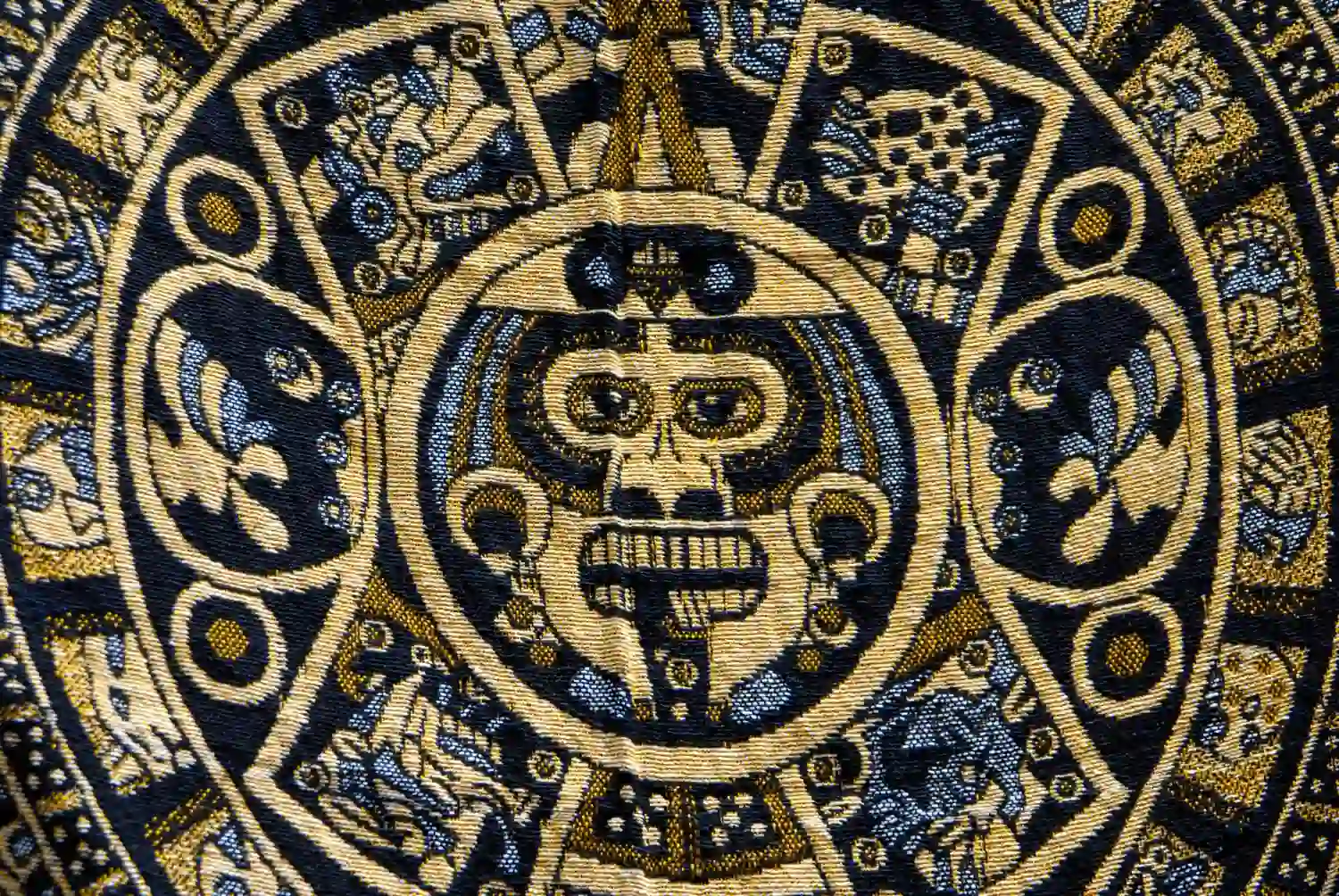
The most famous piece of Aztec art is undoubtedly the Piedra del Sol (Sun Stone). It is a massive basalt monolith, 3.6 meters wide and weighing 24 tons.
People often call it a “calendar,” but it’s much more than a time-tracker. It is a map of history.
- The Center: The face of the Sun God (Tonatiuh), sticking out his tongue (which is a sacrificial knife), demanding blood to keep moving.
- The Rings: The intricate circles depict the four previous eras (or “Suns”) of the world, each of which ended in catastrophe (jaguars, wind, rain of fire, and flood). The Aztecs believed they were living in the fifth era, destined to end by earthquakes.
The level of detail is mind-blowing. Every millimeter is carved with symbols representing days, stars, and gods.
The Math Behind the Myth
Let’s bridge the gap between Art and STEM (Science, Technology, Engineering, Math).
If you are a student of Mathematics, Engineering, or Astronomy, Aztec art proves that art isn’t just about “feelings.” It’s about calculation.
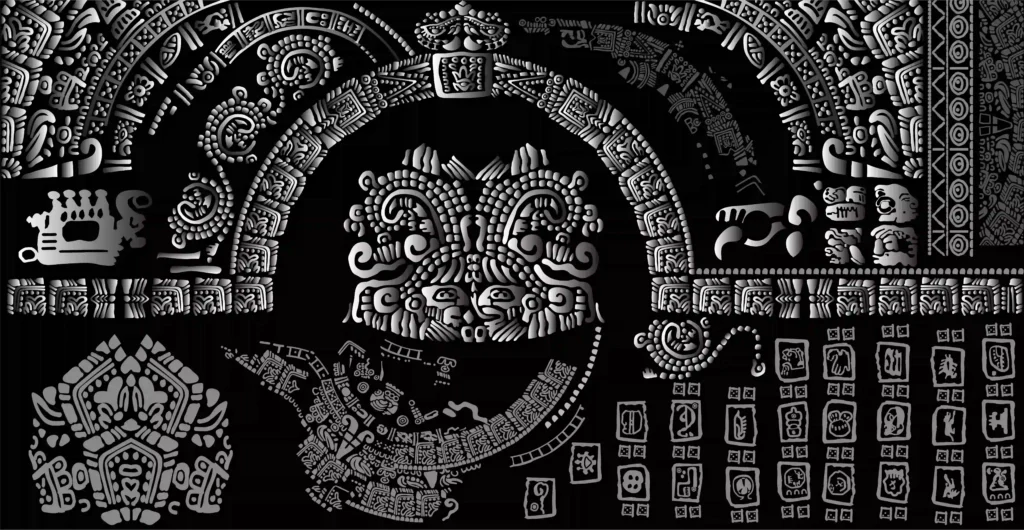
The Sun Stone isn’t just a carving; it is a complex astronomical calculator. The Aztecs were master mathematicians.
- Geometry: Look at the symmetry. Aztec art is obsessed with geometric balance. Using a grid system, they transferred small sketches onto massive boulders with perfect proportions.
- Engineering: Transporting a 24-ton rock from the mountains to the island city without the wheel (yes, they didn’t use wheels for transport) is a feat of civil engineering and physics that rivals the Egyptian pyramids.
Student Takeaway: Interdisciplinary Thinking. In university, we often separate subjects into boxes. “I am a math person” or “I am an art person.” The Aztecs didn’t have these boxes. To them, the movement of the stars (Science), the worship of gods (Religion), and the carving of stone (Art) were all the same thing.
Try this: If you are struggling with a complex problem in physics or coding, try visualizing it. Draw it out. Look for the symmetry. Sometimes, approaching a logical problem with an artistic eye reveals the solution that pure logic missed.
Featherwork: More Precious Than Gold
While we see the stones today, we often miss the most colorful part of Aztec art: Featherwork (Amanteca).
For the Aztecs, quetzal feathers (iridescent green) were more valuable than gold.
- The Penacho: The headdress of Emperor Moctezuma II is a stunning example (currently in a museum in Vienna). It is made of hundreds of Quetzal and other bird feathers, mounted on gold.
- Shields: Warriors carried shields covered in feather mosaics. When they moved in battle, the feathers shimmered and changed color, creating a psychological effect on the enemy.
Imagine the patience required. Artists had to trap birds, harvest a few feathers without hurting them (often releasing them afterwards), and then glue individual feather barbs to create complex images of coyote gods or jaguars. This was the “impressionism” of the Americas.
The Tragedy of the Melted Gold
We know the Aztecs were masters of gold. They called gold Teocuitlatl, which means “Excrement of the Gods.” They didn’t value it for money; they valued it for its yellow, sun-like glow.
Sadly, we have very few examples left. Why? When the Spanish Conquistadors arrived, they didn’t see art. They saw currency. They took thousands of intricate golden statues jaguars, discs, jewelry and melted them down into gold bars to ship back to Europe.
This is a stark lesson in Art History: Art is fragile. Entire cultural libraries can be wiped out by ignorance. The few pieces that survived (mostly those hidden in tombs) show incredible skill in casting and soldering.
Turquoise Mosaics: The Serpent’s Skin
One iconic survivor is the Double-Headed Serpent. It is a wooden sculpture covered in thousands of tiny pieces of turquoise and oyster shell.
- The Symbolism: Snakes represented regeneration (shedding skin) and the earth. A double-headed snake represents the sky and the earth connecting.
- The Craft: Imagine the dexterity needed to cut and paste stones the size of a grain of rice to create a smooth, shimmering surface.
Conclusion: The Sun Still Rises
Aztec art challenges us. It is not “easy” art. It is intense, sometimes scary, and incredibly complex. It reminds us that beauty comes in many forms. It can be the soft smile of a Mona Lisa, or the terrifying, jagged teeth of an Aztec Earth Goddess.
At ArtVibe, we hope this journey through the Elements of Art, the streets of Graffiti, the silence of Japan, the cathedrals of Europe, and the pyramids of Mexico has opened your eyes.
Art is not just something you hang on a wall. It is how humans scream, pray, calculate, and remember. It is the footprint we leave behind.
So, pick up your pencil (or your tablet). Look at the world. Analyze the lines. Find the negative space. And create something. Because one day, someone might look at your work and try to understand who we were.
Comments are closed